
Sinusoidale Beweging van het Reuzenrad
Een reuzenrad met een diameter van 60 voet en een centrum 35 voet boven de grond voltooit één rotatie elke 120 seconden. Modelleer de hoogte van de passagier met een getransformeerde negatieve cosinusfunctie en los vervolgens op om te bepalen hoe lang de passagier boven de 50 voet blijft per rotatie.
Leerbronnen
Deze inhoud maakt deel uit van de open leerbibliotheek van Mathos AI. Ontworpen om studenten te helpen complexe wiskundige problemen te visualiseren en te begrijpen.


Problem
A Ferris wheel has a diameter of feet, a center feet above the ground, and a period of seconds; the rider starts at the bottom at , and the task is to model the height with a transformed negative cosine function and find how long the rider is above feet each rotation.
Step 1: Build the height function
The radius is half the diameter, so the amplitude is feet. Since one revolution takes seconds, the cosine coefficient is
The vertical shift is the center height, , and because the rider starts at the minimum height, the model uses negative cosine:
Step 2: Set up the height condition
To find when the rider is above feet, solve
Subtracting gives
Dividing by flips the inequality:
Step 3: Find the time interval above feet
Cosine is less than when the angle is between and , so
Multiplying through by gives
So the rider is above feet for
seconds during each rotation.
Answer
The height function is , and the rider stays above feet for seconds per rotation.
Concepten
Sinusoidal Modeling
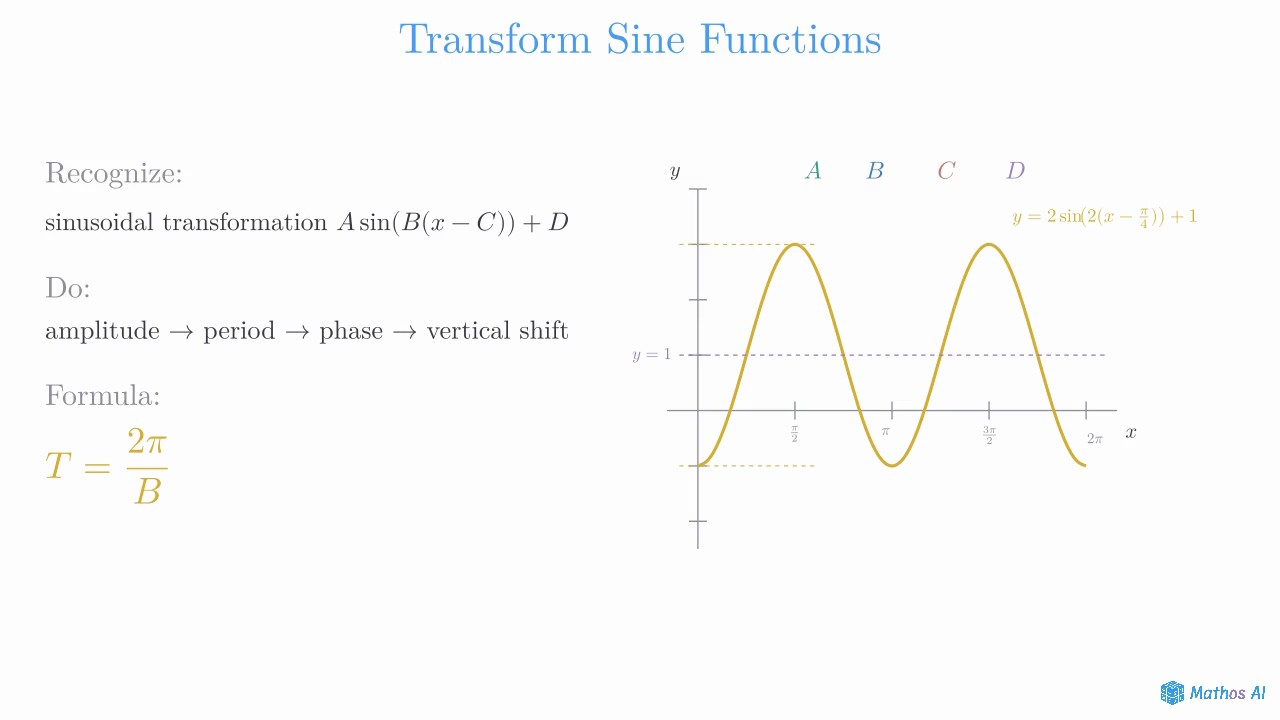
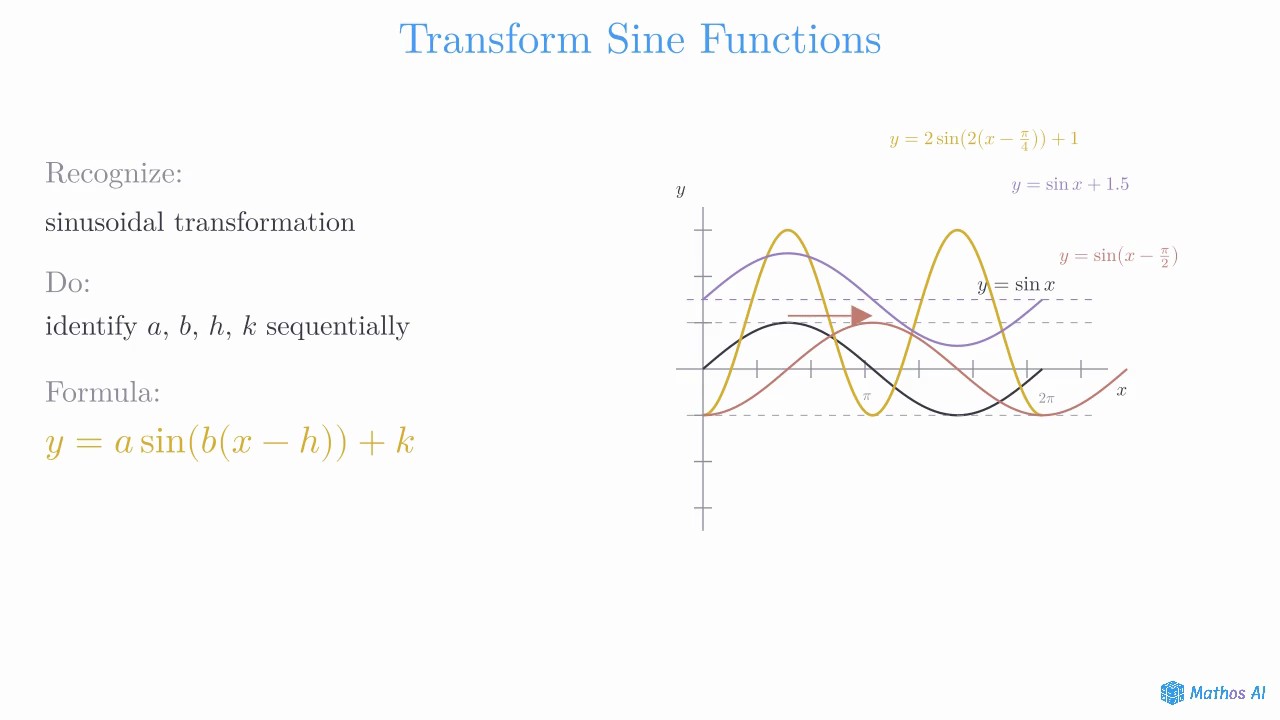
Using sine or cosine functions to model periodic real-world phenomena such as temperature cycles, tides, and circular motion. Determine the amplitude, period, phase shift, and midline from the data.
Meer video's
© 2026 Mathos. Alle rechten voorbehouden