
관람차의 사인 곡선 운동
60피트 지름의 관람차가 지면에서 35피트 높이에 위치하며, 120초마다 한 바퀴를 회전합니다. 변형된 음의 코사인 함수를 사용하여 탑승자의 높이를 모델링한 후, 탑승자가 한 바퀴 회전 동안 50피트 이상 머무는 시간을 구하세요.


Problem
A Ferris wheel has a diameter of feet, a center feet above the ground, and a period of seconds; the rider starts at the bottom at , and the task is to model the height with a transformed negative cosine function and find how long the rider is above feet each rotation.
Step 1: Build the height function
The radius is half the diameter, so the amplitude is feet. Since one revolution takes seconds, the cosine coefficient is
The vertical shift is the center height, , and because the rider starts at the minimum height, the model uses negative cosine:
Step 2: Set up the height condition
To find when the rider is above feet, solve
Subtracting gives
Dividing by flips the inequality:
Step 3: Find the time interval above feet
Cosine is less than when the angle is between and , so
Multiplying through by gives
So the rider is above feet for
seconds during each rotation.
Answer
The height function is , and the rider stays above feet for seconds per rotation.
개념
Sinusoidal Modeling
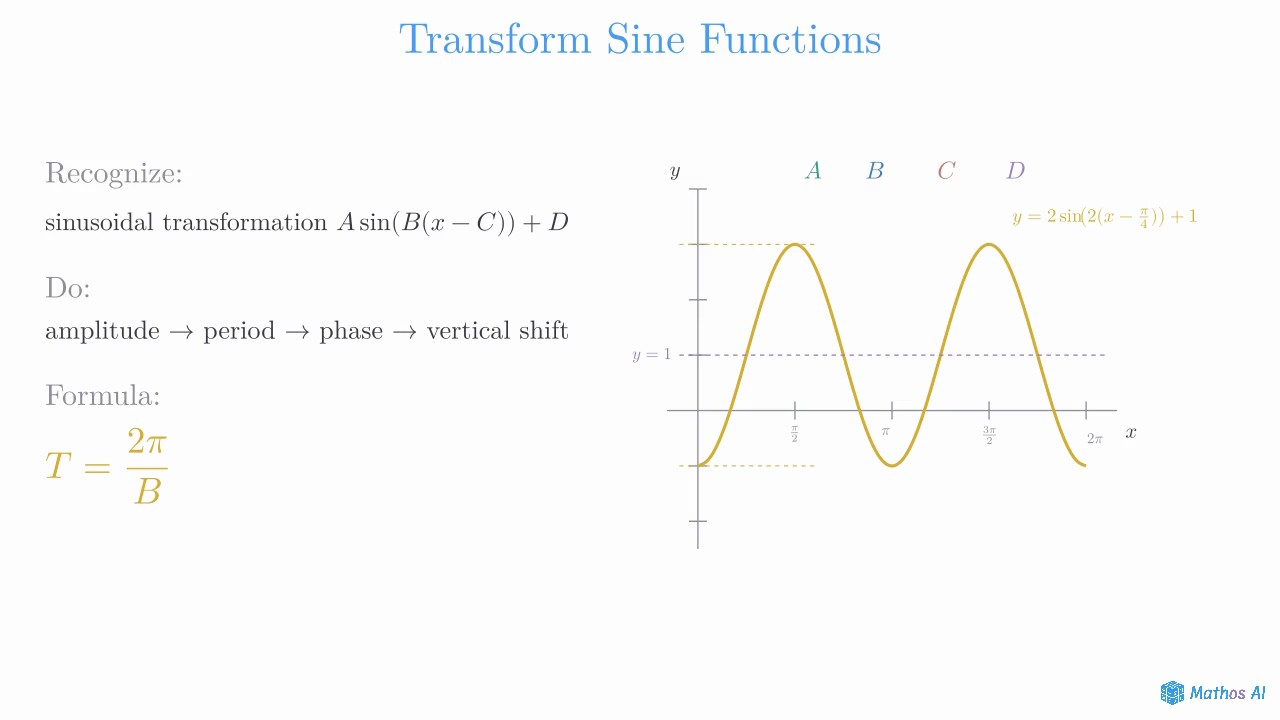
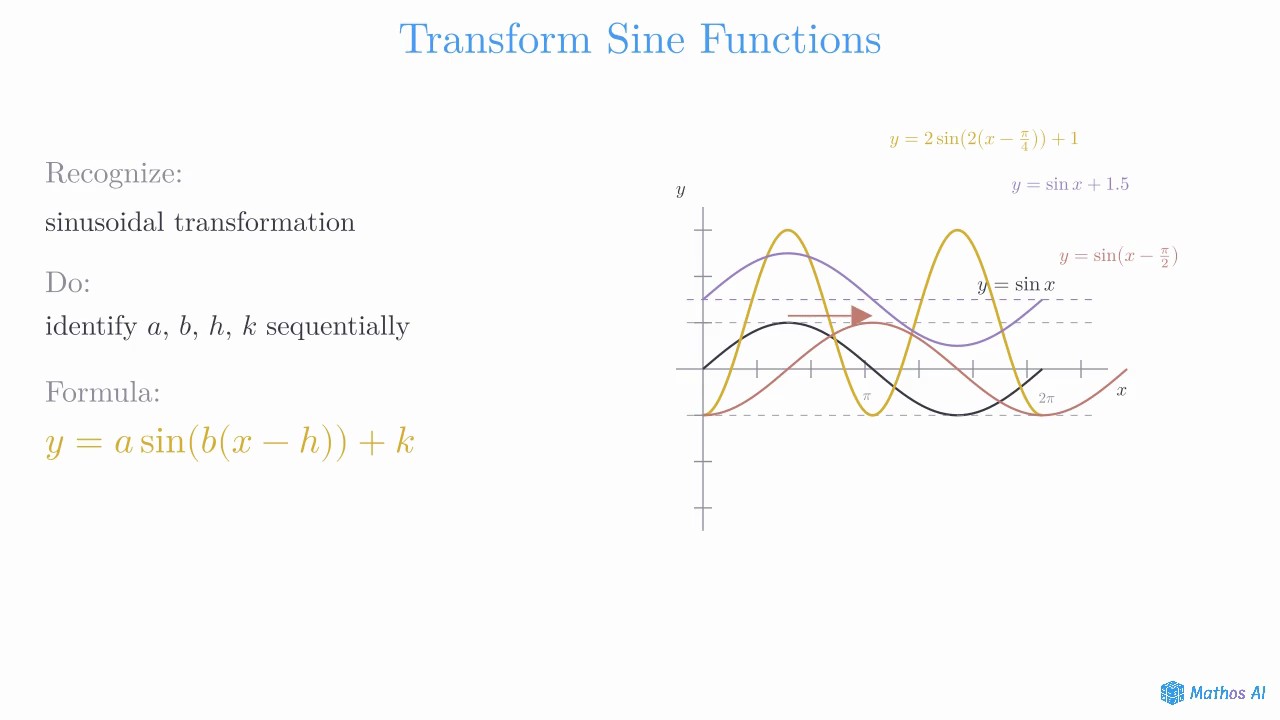
Using sine or cosine functions to model periodic real-world phenomena such as temperature cycles, tides, and circular motion. Determine the amplitude, period, phase shift, and midline from the data.
더 많은 동영상
© 2026 Mathos. 모든 권리 보유