
Punto equidistante per A(5,1), B(-3,-7), C(7,-1)
Scopri come trovare il punto equidistante da A(5,1), B(-3,-7) e C(7,-1) usando le distanze al quadrato e un sistema di equazioni lineari.
Risorse di Apprendimento
Questo contenuto fa parte della biblioteca di apprendimento aperto di Mathos AI. Progettato per aiutare gli studenti a visualizzare e comprendere problemi matematici complessi.


Problem
Find the point that is equidistant from , , and .
Step 1: Write Equal-Distance Equations
Let the unknown point be . To avoid square roots, compare squared distances.
Set the squared distance from to equal to the squared distance from to :
This simplifies to:
Now set the squared distance from to equal to the squared distance from to :
This simplifies to:
Step 2: Solve the Line System
The two equations are:
and
Add the equations to eliminate :
So:
Substitute back into :
Therefore:
So the candidate point is:
Step 3: Check the Equal Distances
Check the squared distance from to each point.
To :
To :
To :
Each squared distance is , so the point equidistant from , , and is:
Concetti
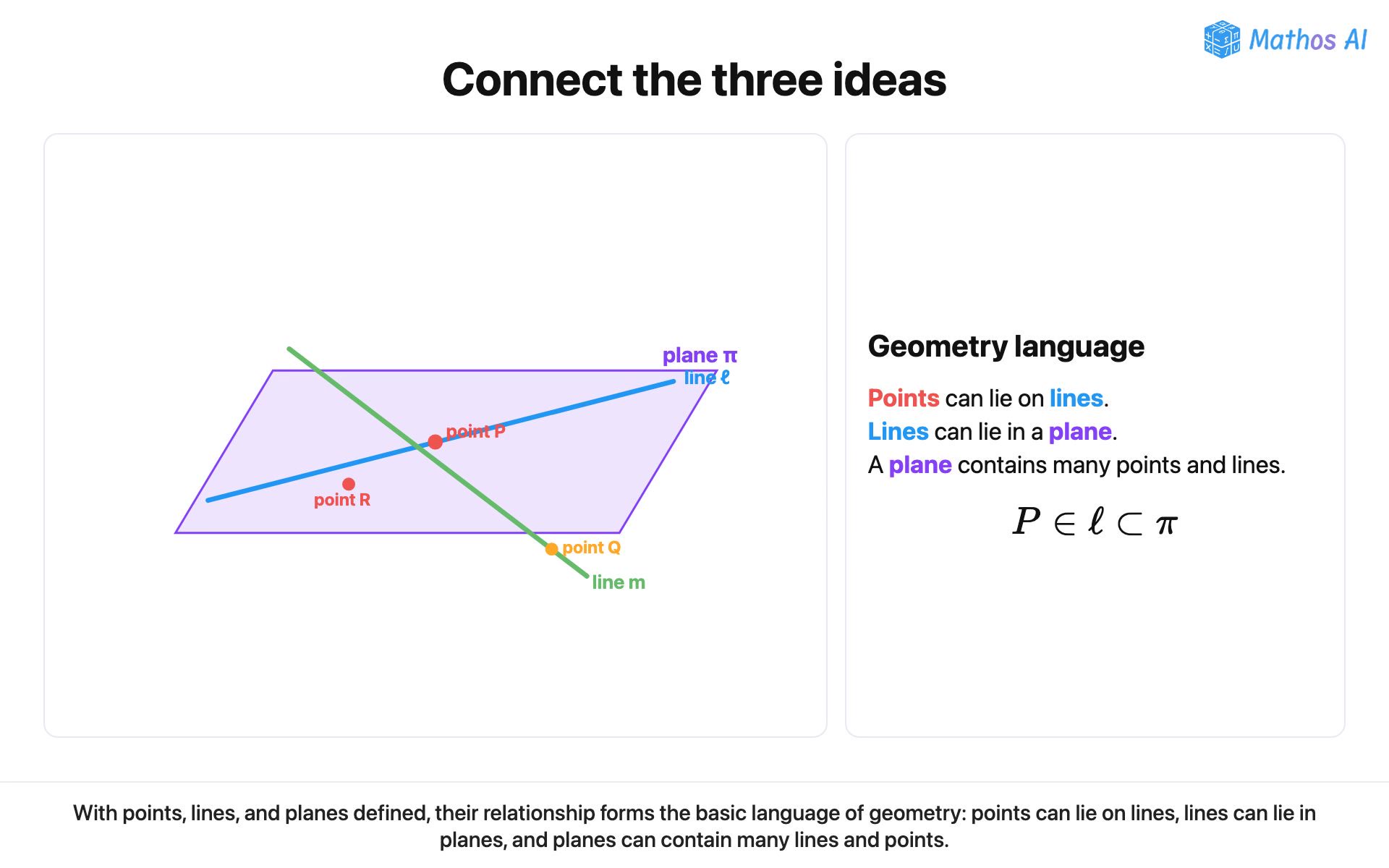
Points, Lines, Segments, and Planes
Fundamental geometric objects and their measurements. Includes the segment addition postulate, the midpoint formula, and the distance formula on the coordinate plane.
Coordinate Geometry of Lines
Using slopes in the coordinate plane to determine whether lines are parallel (equal slopes) or perpendicular (slopes are negative reciprocals). Includes finding the equation of a line through a point with a given slope condition, and the distance from a point to a line.
Altri video
© 2026 Mathos. Tutti i diritti riservati