
Mouvement Sinusoïdal de la Grande Roue
Une grande roue de 60 pieds de diamètre et dont le centre est à 35 pieds au-dessus du sol effectue une rotation complète toutes les 120 secondes. Modélisez la hauteur du passager avec une fonction cosinus négatif transformée, puis résolvez pour déterminer combien de temps le passager reste au-dessus de 50 pieds par rotation.
Ressources d'Apprentissage
Ce contenu fait partie de la bibliothèque d'apprentissage ouvert Mathos AI. Conçu pour aider les étudiants à visualiser et comprendre les problèmes mathématiques complexes.


Problem
A Ferris wheel has a diameter of feet, a center feet above the ground, and a period of seconds; the rider starts at the bottom at , and the task is to model the height with a transformed negative cosine function and find how long the rider is above feet each rotation.
Step 1: Build the height function
The radius is half the diameter, so the amplitude is feet. Since one revolution takes seconds, the cosine coefficient is
The vertical shift is the center height, , and because the rider starts at the minimum height, the model uses negative cosine:
Step 2: Set up the height condition
To find when the rider is above feet, solve
Subtracting gives
Dividing by flips the inequality:
Step 3: Find the time interval above feet
Cosine is less than when the angle is between and , so
Multiplying through by gives
So the rider is above feet for
seconds during each rotation.
Answer
The height function is , and the rider stays above feet for seconds per rotation.
Concepts
Sinusoidal Modeling
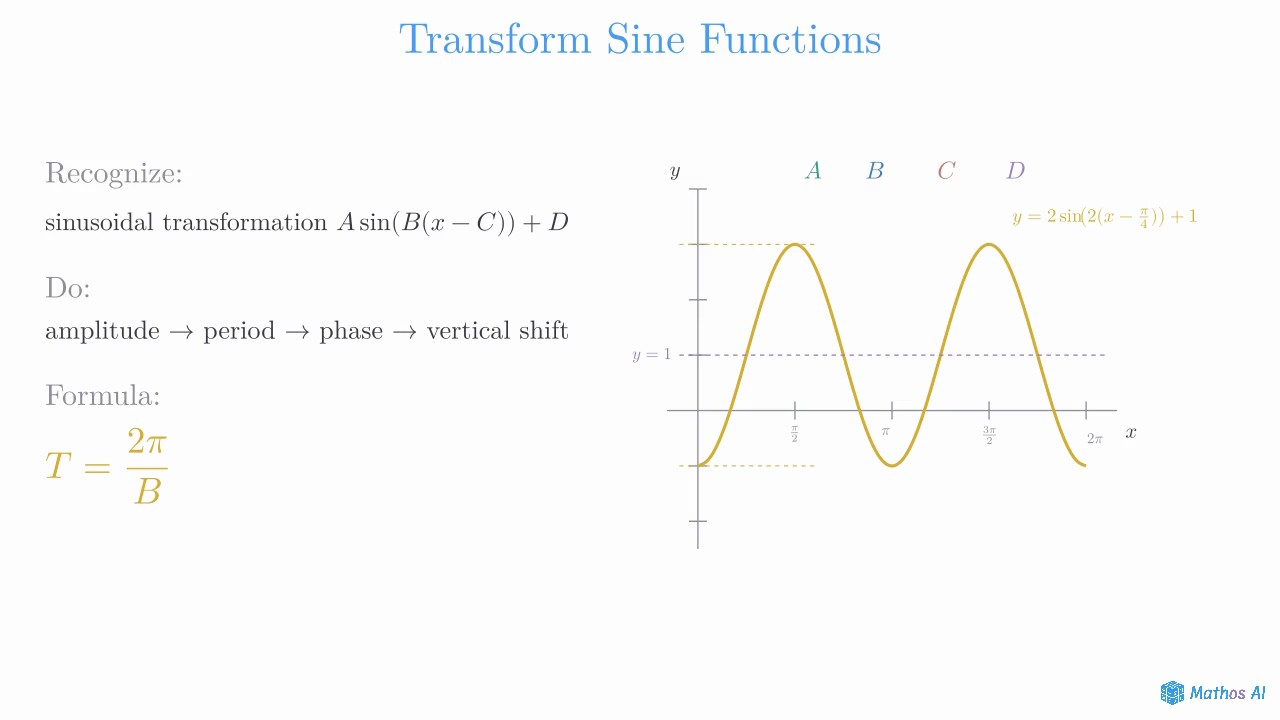
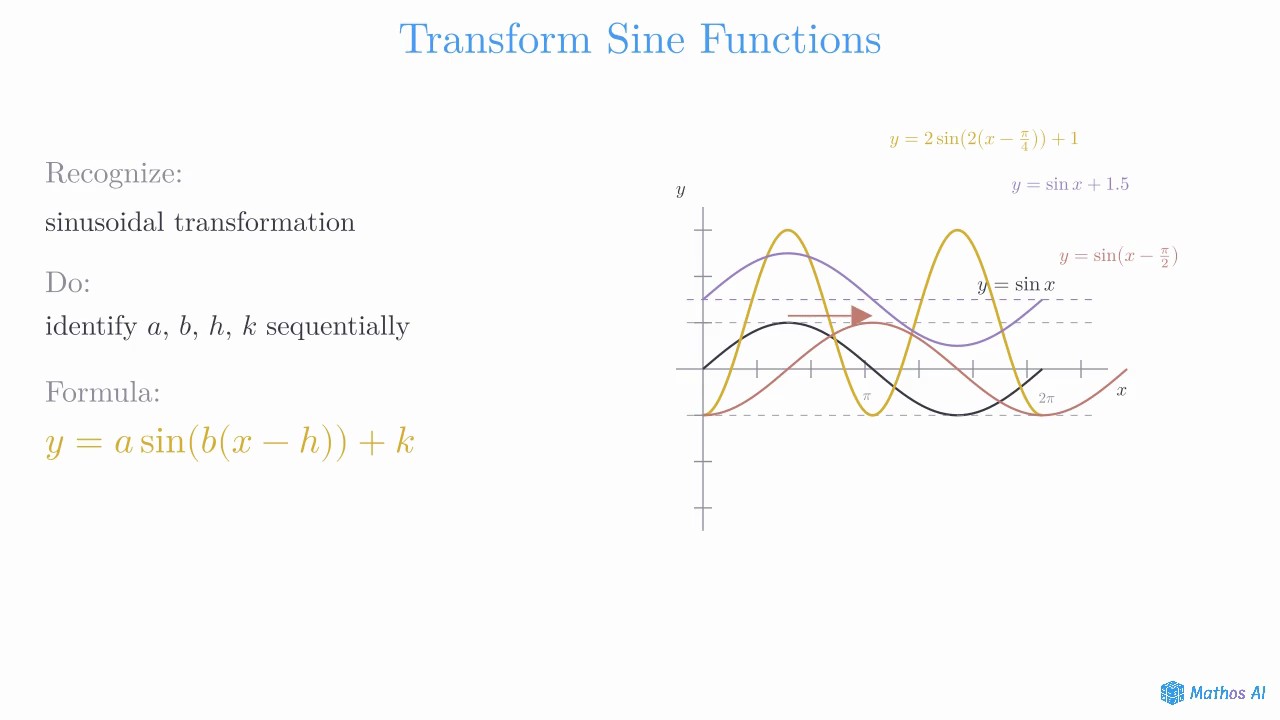
Using sine or cosine functions to model periodic real-world phenomena such as temperature cycles, tides, and circular motion. Determine the amplitude, period, phase shift, and midline from the data.
Plus de vidéos
© 2026 Mathos. Tous droits réservés