
Movimiento Sinusoidal de la Noria
Una noria con un diámetro de 60 pies y un centro a 35 pies sobre el suelo completa una rotación cada 120 segundos. Modela la altura del pasajero con una función coseno negativa transformada, luego resuelve para encontrar cuánto tiempo el pasajero permanece por encima de 50 pies por rotación.
Recursos de Aprendizaje
Este contenido es parte de la biblioteca de aprendizaje abierta de Mathos AI. Diseñado para ayudar a los estudiantes a visualizar y comprender problemas matemáticos complejos.


Problem
A Ferris wheel has a diameter of feet, a center feet above the ground, and a period of seconds; the rider starts at the bottom at , and the task is to model the height with a transformed negative cosine function and find how long the rider is above feet each rotation.
Step 1: Build the height function
The radius is half the diameter, so the amplitude is feet. Since one revolution takes seconds, the cosine coefficient is
The vertical shift is the center height, , and because the rider starts at the minimum height, the model uses negative cosine:
Step 2: Set up the height condition
To find when the rider is above feet, solve
Subtracting gives
Dividing by flips the inequality:
Step 3: Find the time interval above feet
Cosine is less than when the angle is between and , so
Multiplying through by gives
So the rider is above feet for
seconds during each rotation.
Answer
The height function is , and the rider stays above feet for seconds per rotation.
Conceptos
Sinusoidal Modeling
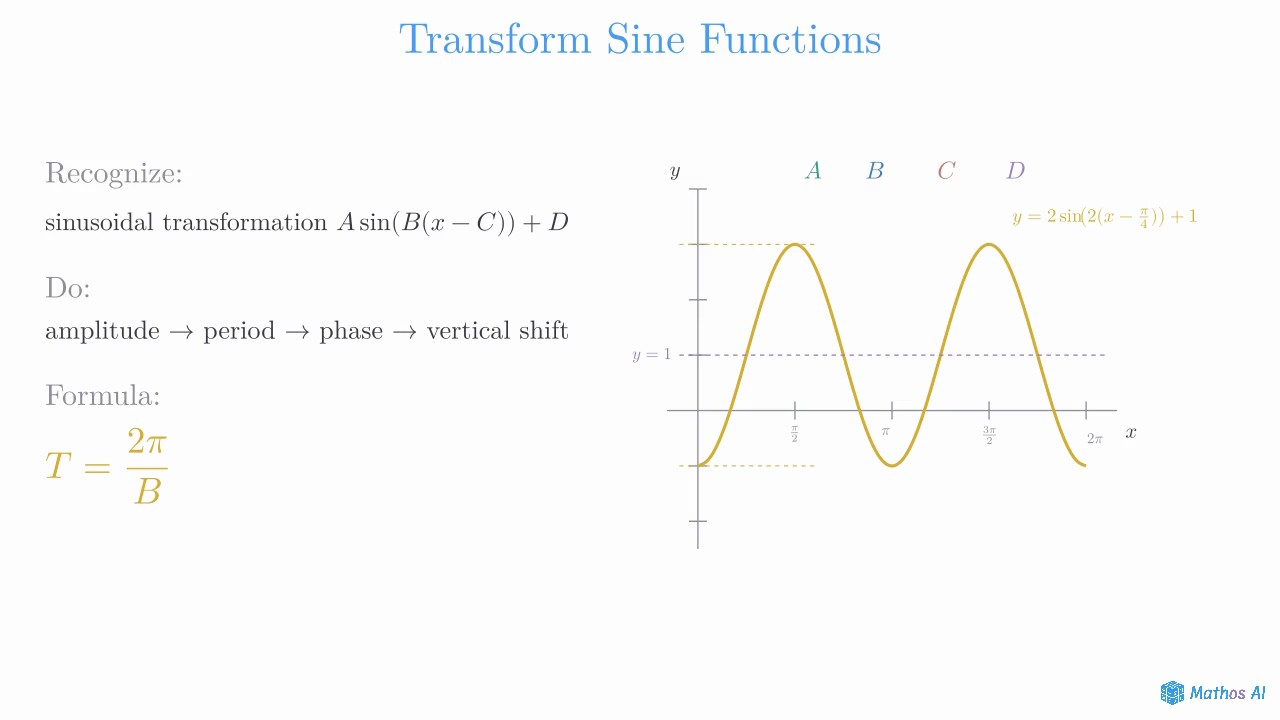
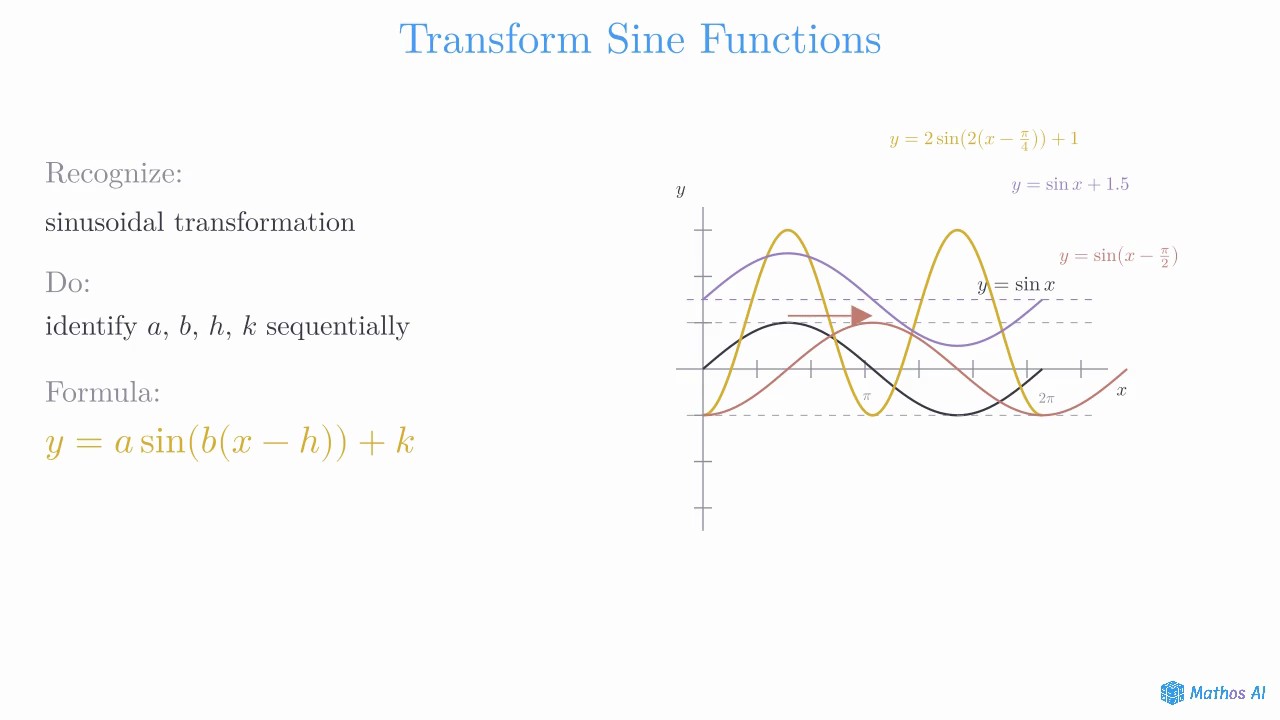
Using sine or cosine functions to model periodic real-world phenomena such as temperature cycles, tides, and circular motion. Determine the amplitude, period, phase shift, and midline from the data.
Más vídeos
© 2026 Mathos. Todos los derechos reservados