
Sinusoidale Bewegung des Riesenrades
Ein Riesenrad mit einem Durchmesser von 60 Fuß und einem Mittelpunkt 35 Fuß über dem Boden vollendet eine Umdrehung alle 120 Sekunden. Modellieren Sie die Höhe des Fahrgastes mit einer transformierten negativen Kosinusfunktion und lösen Sie, um herauszufinden, wie lange der Fahrgast pro Umdrehung über 50 Fuß bleibt.
Lernressourcen
Dieser Inhalt ist Teil der offenen Lernbibliothek von Mathos AI. Entwickelt, um Studenten zu helfen, komplexe mathematische Probleme zu visualisieren und zu verstehen.


Problem
A Ferris wheel has a diameter of feet, a center feet above the ground, and a period of seconds; the rider starts at the bottom at , and the task is to model the height with a transformed negative cosine function and find how long the rider is above feet each rotation.
Step 1: Build the height function
The radius is half the diameter, so the amplitude is feet. Since one revolution takes seconds, the cosine coefficient is
The vertical shift is the center height, , and because the rider starts at the minimum height, the model uses negative cosine:
Step 2: Set up the height condition
To find when the rider is above feet, solve
Subtracting gives
Dividing by flips the inequality:
Step 3: Find the time interval above feet
Cosine is less than when the angle is between and , so
Multiplying through by gives
So the rider is above feet for
seconds during each rotation.
Answer
The height function is , and the rider stays above feet for seconds per rotation.
Konzepte
Sinusoidal Modeling
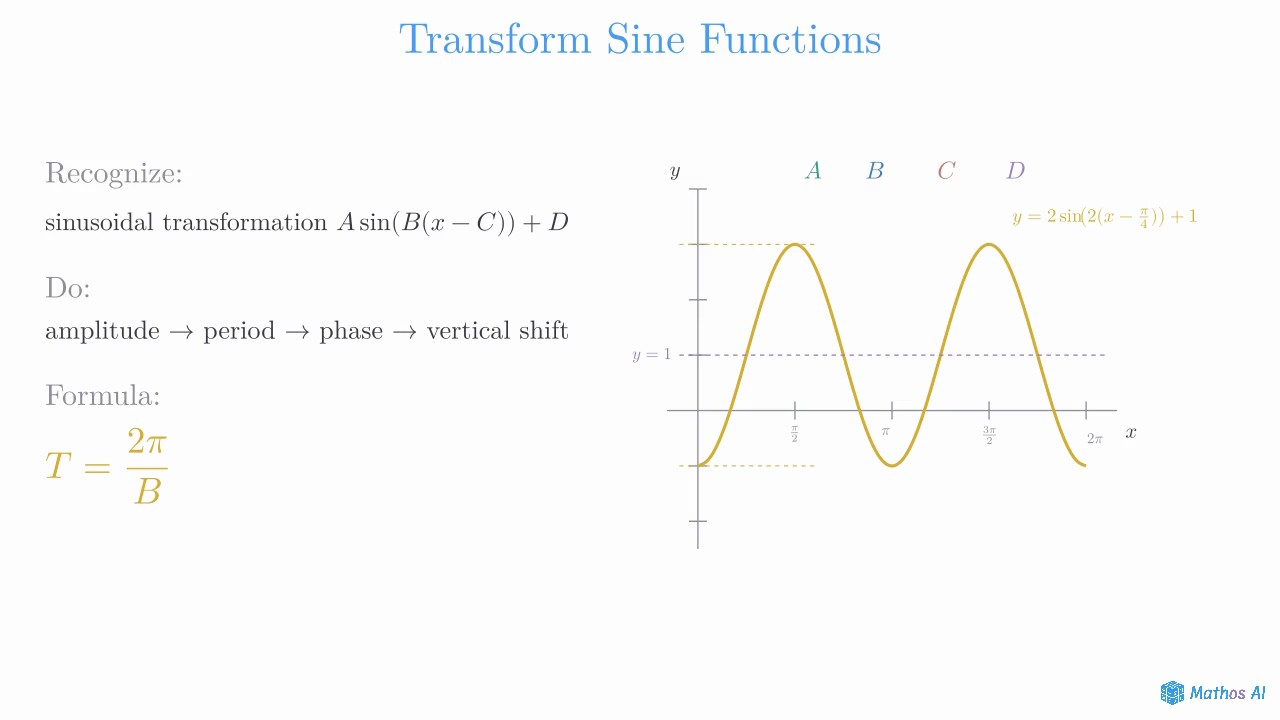
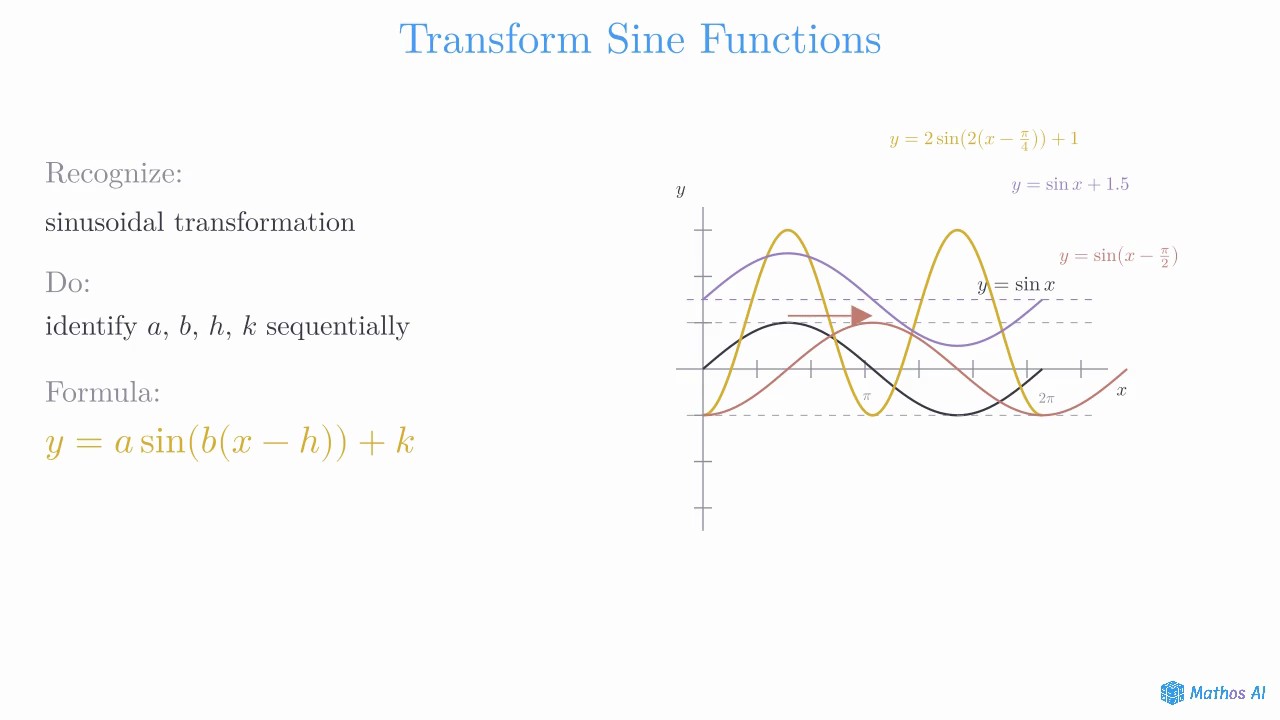
Using sine or cosine functions to model periodic real-world phenomena such as temperature cycles, tides, and circular motion. Determine the amplitude, period, phase shift, and midline from the data.
Weitere Videos
© 2026 Mathos. Alle Rechte vorbehalten