
Gleich weit von A(5,1), B(-3,-7), C(7,-1)
Lerne, wie man den Punkt findet, der von A(5,1), B(-3,-7) und C(7,-1) gleich weit entfernt ist, mit quadrierten Abständen und einem Gleichungssystem.
Lernressourcen
Dieser Inhalt ist Teil der offenen Lernbibliothek von Mathos AI. Entwickelt, um Studenten zu helfen, komplexe mathematische Probleme zu visualisieren und zu verstehen.


Problem
Find the point that is equidistant from , , and .
Step 1: Write Equal-Distance Equations
Let the unknown point be . To avoid square roots, compare squared distances.
Set the squared distance from to equal to the squared distance from to :
This simplifies to:
Now set the squared distance from to equal to the squared distance from to :
This simplifies to:
Step 2: Solve the Line System
The two equations are:
and
Add the equations to eliminate :
So:
Substitute back into :
Therefore:
So the candidate point is:
Step 3: Check the Equal Distances
Check the squared distance from to each point.
To :
To :
To :
Each squared distance is , so the point equidistant from , , and is:
Konzepte
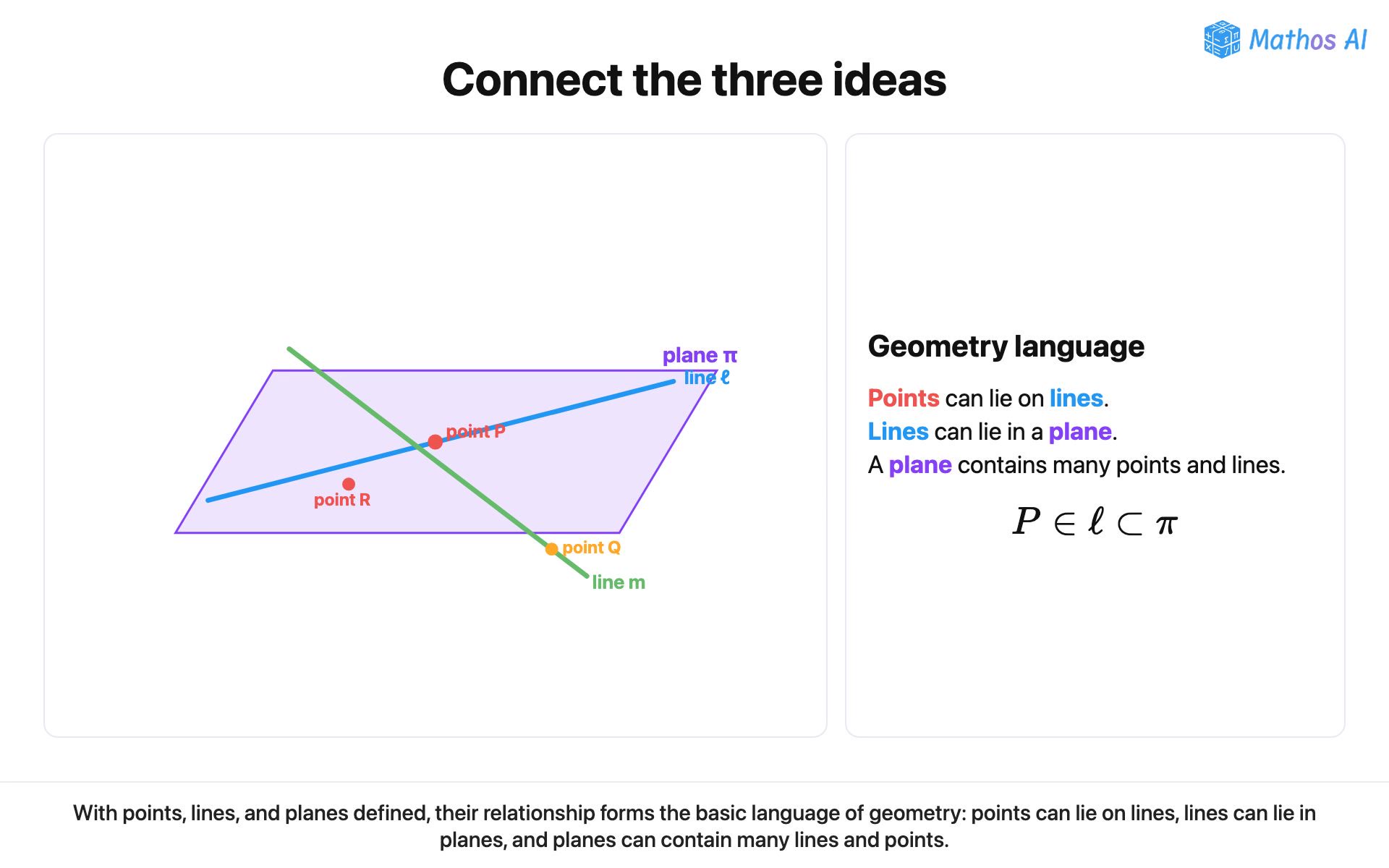
Points, Lines, Segments, and Planes
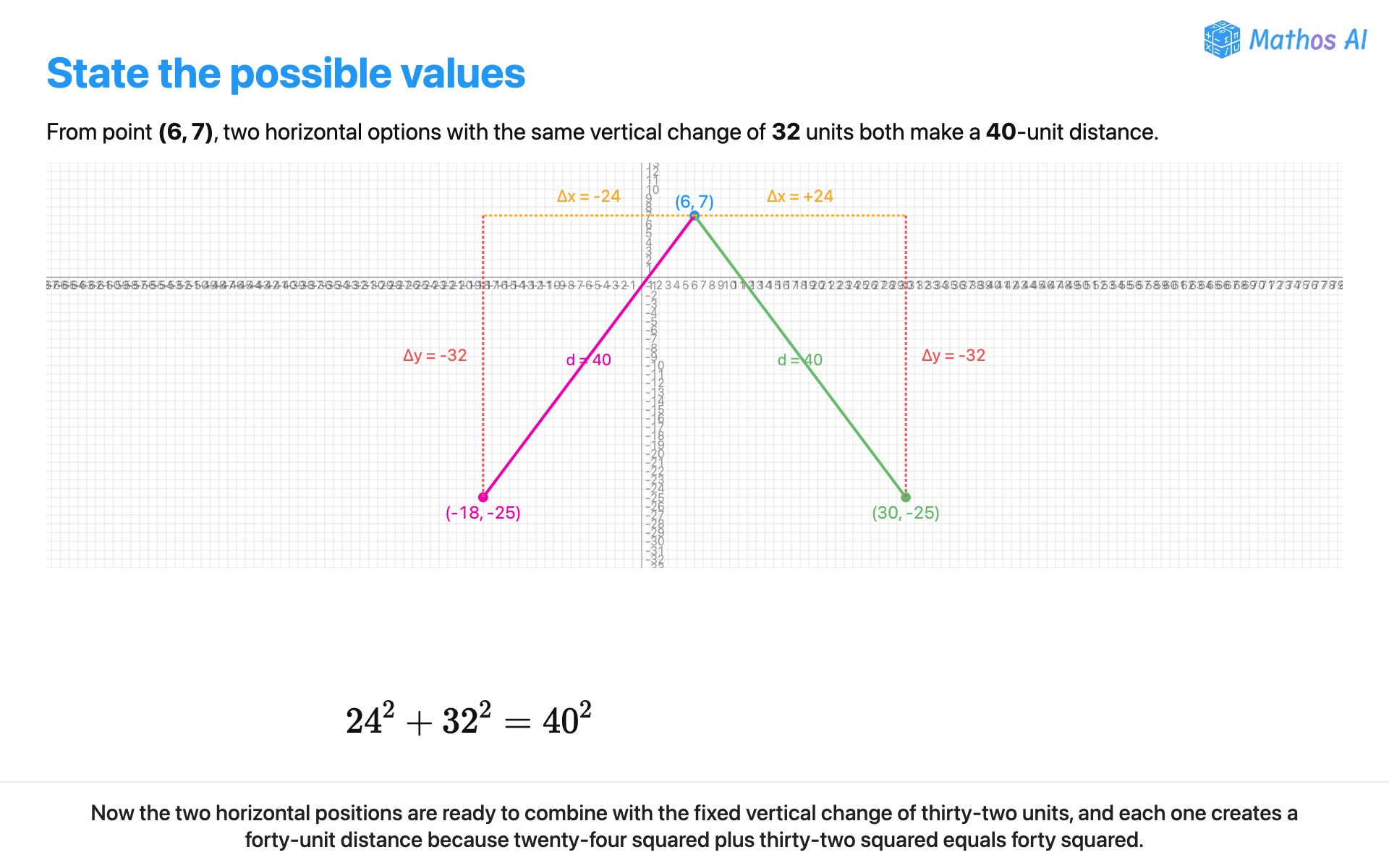
Fundamental geometric objects and their measurements. Includes the segment addition postulate, the midpoint formula, and the distance formula on the coordinate plane.
Coordinate Geometry of Lines
Using slopes in the coordinate plane to determine whether lines are parallel (equal slopes) or perpendicular (slopes are negative reciprocals). Includes finding the equation of a line through a point with a given slope condition, and the distance from a point to a line.
Weitere Videos
© 2026 Mathos. Alle Rechte vorbehalten