
4 Reasons You Must Take AP Math
Monday, January 20, 2025
AP Math classes are college-level math courses offered in high school, allowing students to earn college credits while still in high school, practice critical problem-solving, and prepare for rigorous college coursework. Taking AP classes in high school has many benefits, but you need a strategic studying plan to score high.
For example, Jacob Wong, our user (Mathos AI) is going to Ohio State University. He took AP Calculus BC and got a 5 on the exam. According to Ohio State's AP policy, she could get an advanced placement and skip introductory college math classes. This can save him 5 to 10 credit hours, which means he can save at least around $1900 in tuition. It wasn't easy for her to get a 5 because AP Calculus BC is one of the hardest AP courses.
Embrace the challenge! Although some courses can be challenging, you can do it if you choose the right course and prepare well for the exams.
We put together this helpful guide about AP Math, where you can find the AP Math course, the benefits of taking AP Math, which AP class to take, and tips to get ready for AP Math exams.
What Are The AP Math Courses
AP Math courses are designed to challenge students with advanced mathematical concepts and prepare them for college-level work. There are four AP math courses offered by the College Board: AP Calculus AB, AP Calculus BC, and AP Statistics. Let's quickly go over the course options.
AP Precalculus
What is AP Precalculus? Some of you might not be familiar with this course, because it's a new AP Math course added by the College Board in 2023.
AP Precalculus is designed to help more students build a stronger foundation in math to perform better in college-level math courses.
In AP Precalculus, you'll learn how to manipulate algebraic expressions, translate mathematical information between representations (tables, graphs, equations, etc), explain mathematical reasoning concisely, Trigonometry, and more.
Who should take AP Precalculus?
It's designed for students who plan to take AP Calculus AB and BC because it builds a strong foundation and provides guidance for critical problem-solving skills. AP Precalculus is also a good starter course for students who want to major in the STEM (science, technology, engineering, and mathematics) field in college.
If you're fascinated by the intricate patterns in nature and want a career in biology or environmental science, AP Precalculus offers a crucial advantage. It goes beyond basic math, fostering a deep understanding of mathematical concepts. This allows you to excel in AP Calculus and develop critical thinking and problem-solving skills to analyze complex biological systems, model ecological interactions, and contribute to scientific discoveries.
Note: Some schools might require you to pass Algebra 2 (or equivalent) before you can take AP Precalculus. Make sure to check with your teacher before enrolling.
AP Calculus AB
AP Calculus AB is a high school AP Math course equivalent to the first semester of college calculus. You'll learn to analyze functions, calculate limits, and master derivatives and integrals. It will also help you develop your mathematical reasoning and problem-solving skills.
Who should take AP Calculus AB?
Students who usually get high grades in Geometry, Precalculus, and Algebra 2 can consider taking this course. Otherwise, you might find it challenging. So if math is not your strong subject, you might want to consider taking Pre-calc before Calculus AB to get more prepared.
For example, Sarah, a student we tutored, excelled in precalculus and enjoys the challenge of complex math problems. Taking AP Calculus AB will provide her with the necessary calculus skills for her future engineering studies, potentially allowing her to graduate college sooner and begin her career in environmental engineering.
AP Calculus BC
Many people ask "What's the difference between AP Calculus AB and BC?"
The major difference is that AP Calculus BC covers more topics than AP Calculus AB, and it's harder.
You can consider Calculus BC the next level of Calculus AB as it covers deeper mathematical topics beyond the basics. AP Calculus BC covers the first and second semesters of college calculus. You'll learn everything covered in Calculus AB, plus more complex topics like parametric equations, polar coordinates, and series and sequences.
Who should take AP Calculus BC?
This challenging course is designed for highly motivated students who want to pursue STEM majors. If you enjoy challenges, AP Calculus BC is a rigorous course that demands dedication, independent study, and self-discipline.
Let's say you're fascinated by the intricacies of artificial intelligence. You want to develop cutting-edge AI algorithms that can revolutionize fields like medicine or environmental science. AP Calculus BC provides the essential mathematical foundation for this ambition. By mastering concepts like differential equations and multivariable calculus, you will gain the critical thinking and problem-solving skills necessary to tackle the complex mathematical challenges inherent in AI research and development.
AP Statistics
AP Statistics is a non-calculus course that introduces students to the major concepts and tools for collecting, analyzing, and drawing conclusions from data. You're expected to learn how to analyze datasets, design and conduct studies, work with probability models, and conclude data.
Who should take AP Statistics?
Students who want to take AP Statistics must complete a second-year algebra course. It's suitable for students who have strong reading/reasoning skills and plan to major in Psychology, Economics, Biology, or majors that require statistical knowledge. You can also take this course if you want to improve your data analysis skills.
4 Reasons Why You Should Take AP Math
Taking Advanced Placement math helps you save time and money in college, boosts your academic profile, and prepares you for real-world problem-solving, etc. Here are four benefits of taking AP Math in high school.
- Earn college credits or get advanced placement
You can save money on college tuition because college credits are more expensive than AP exams. Most college courses are 3 to 4 credits, and each credit costs about $400 for an in-state student at a public university.
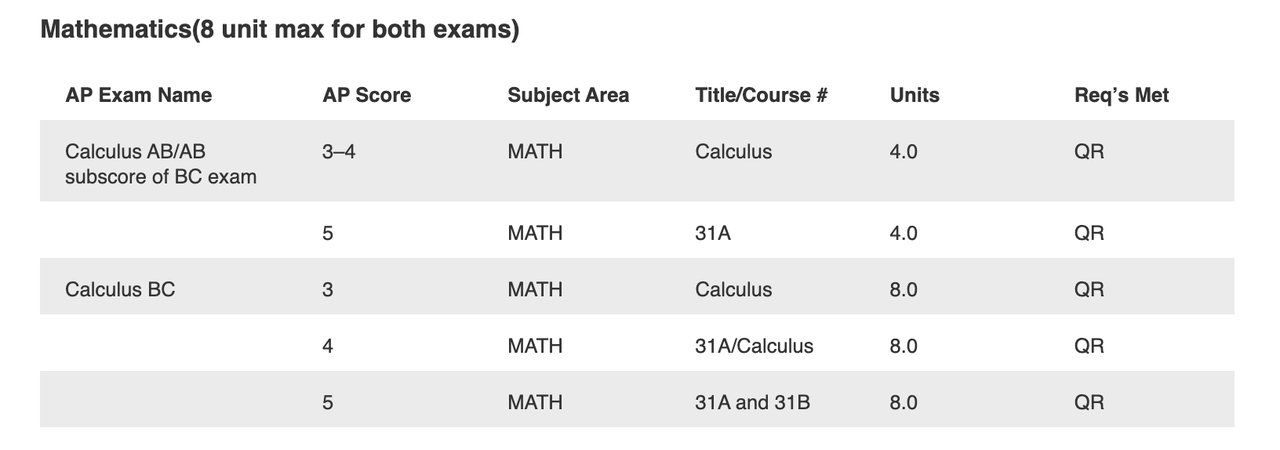
For instance, scoring a 5 on the AP Calculus BC exam at UCLA can earn you 8 quarter units, equivalent to two college-level calculus courses. This could potentially save thousands of dollars in tuition and allow you to graduate earlier or take more advanced courses.
- Show a competitive advantage in college admission
AP classes are more challenging than regular high school classes, so taking these classes demonstrates your ability to handle rigorous coursework.
Success in AP Calculus can set you apart when applying to STEM-focused programs because it shows that you are ready for college-level math and willing to challenge yourself academically.
- Develop essential skills for college majors or future careers
AP Statistics and AP Calculus can benefit students considering STEM, economics, business, or social sciences majors, as these fields often require strong quantitative and analytical skills.
Let's say that you're a physics major studying motion, you'll need to calculate the trajectory of a projectile under the influence of gravity. You can use derivatives from AP Calculus to calculate velocity and acceleration, and integrals to determine displacement and the overall trajectory of a projectile under the influence of gravity.
Besides academic skills, you'll also develop problem-solving and critical-thinking skills.
- Prepare yourself for college and have a stress-free academic experience
The learning styles in high school and college are completely different. For example, in high school, students are guided by teachers most of the time, while at university, you'll have to figure out a lot of things on your own. Many students are not used to studying independently in the first semester and find it challenging to follow along with the courses.
AP classes are like a transition between high school and college. Although it's a high school course and you'll be guided by teachers, its goal is to develop your independent studying and self-problem-solving skills, which are essential for college.
Which AP Math Should You Take: What to Consider
So how do you choose an AP Math course? It's important to choose the AP course wisely so that you won't fail the course. Here are a few things to consider:
- Your current math level
It's tempting to take AP Calculus BC because it could be most helpful for your college application, but make sure you have a solid grasp of algebra, geometry, and trigonometry before taking AP Calculus. If you're not confident with math and want to take an AP course, AP Precalculus can help build a stronger foundation in math.
Can't decide which math level you have? Talk to your academic advisor before enrolling in an AP course.
- Your future goals
What you plan to major in college can also help you determine which AP Math to take. If you plan to pursue a STEM major, AP Calculus BC is the best choice as it demonstrates your academic skills and is equivalent to two semesters of college calculus, allowing you more time to focus on other STEM courses.
If you're interested in business or social sciences majors like psychology and sociology that are more data-based, taking AP Statistics is your best choice.
- Workload and time management
AP Calculus is a challenging course for many. It can take a lot of time and effort if you're not confident in math. Evaluate whether you can handle the workload and won't get over-stressed. AP Statistics is less intense, but it requires a lot of self-study and reasoning. So you'll expect some extra hours after class to solve the problems.
If you already have a tight schedule, consider an easier AP math class like AP Precalculus that won't exhaust you while building a stronger foundation for your next AP Math course.
4 Tips to Prepare for AP Math Exams
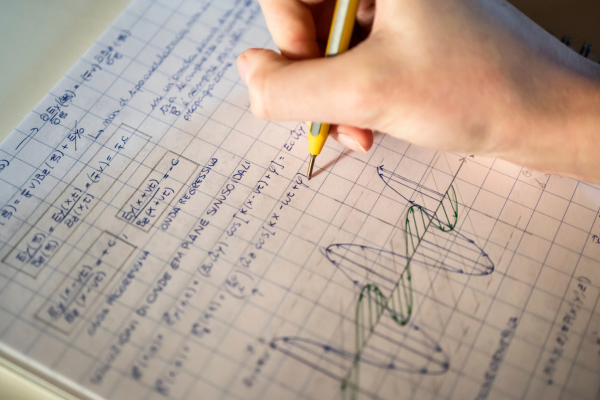
Conquering AP Math exams hinges on a solid grasp of core concepts, pinpointing and tackling your weak spots, leveraging top-notch resources, developing effective study habits, approaching the exam with a clear head, and showing your work!
- Master the core concepts
Memorize essential derivatives and integrals of common trigonometric and other functions. For example, memorize the unit circle to calculate trig values quickly without a calculator. Mastering the key concepts will help you apply concepts to unfamiliar problems during the exam.
A good technique for long-term memory is spaced repetition. Review new information immediately and repeatedly at an increasing interval. The goal is to have fresh memories of what you just learned.
- Practice consistently
Spend at least 30 minutes a day practicing your weakness on the course. Practice 5 to 10 problems a day for two weeks before the exam to get familiar with different problem types and improve your overall performance. When you practice exams, try to set a time. The standard time for the multiple-choice section is 1 hour and 45 minutes and the free response section is 1 hour and 30 minutes.
You can find practice problems organized by unit and concept, and full AP Calculus AB and BC practice exams on resources like Albert.io.
- Use calculator wisely
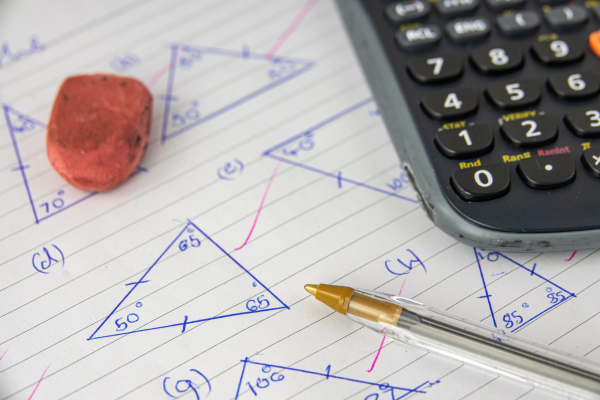
You can use a math calculator during part of the AP Math exams (Multiple Choice Part B and Free Response Part A), effectively using a calculator during the exam can save time and solve problems faster. Make sure you are proficient with your device's functions.
Practice using your calculator for graphing, solving equations, and performing complex calculations. Remember to store interim values in your calculator for multi-step problems to maintain accuracy in your final answers.
- Manage your time effectively during the exam
For example, the AP Calculus AB exam is 3 hours and 15 minutes long. It consists of two main sections and each section accounts for 50% of the total exam score.
Multiple-Choice Section: 1 hour and 45 minutes
- Part A: 60 minutes, 30 questions (no calculator)
- Part B: 45 minutes, 15 questions (calculator required)
Free-Response Section: 1 hour and 30 minutes
- Part A: 30 minutes, 2 questions (calculator required)
- Part B: 60 minutes, 4 questions (no calculator)
Plan your time wisely during the exam. For multiple choice questions, try not to spend more than 2 minutes on each question. Aim for about 15 minutes for each free-response question.
Always answer the questions you're confident with first, then go back to the challenging ones.
Conclusion
Taking AP Math courses offers many benefits for high school students preparing for college and future careers. These courses provide opportunities to earn college credits, develop critical thinking skills, and gain a competitive edge in college admissions. Whether you choose AP Precalculus, AP Calculus AB, AP Calculus BC, or AP Statistics, each course offers unique advantages tailored to different academic goals and career paths.
FAQs
What math do you need for AP stats?
You should finish second-year Algebra before taking AP Statistics and have a solid foundation in basic mathematical concepts like basic algebra, data interpretation, probability concepts, etc.
Is AP Calculus hard?
AP Calculus AB is challenging, while Calculus BC is considered the hardest AP math course that demands strong mathematical skills, dedication, and independent study. Calculus BC is harder than Calculus AB because it covers more advanced mathematical topics like parametric equations, polar coordinates, and series and sequences.
Can you take AP Calculus and AP Statistics at the same time?
If you have a strong math background and can manage the workload, why not? However, be mindful of the time commitment.
What if you don’t score well on the AP exam?
Many colleges evaluate your overall performance, not just the exam score. Plus, they may still value the effort of taking the AP course.
Take it as a learning experience and know where you need more help. Finding a math tutor to help you with specific topics you're not confident about is also a good idea. When you're ready, you can retake the exam.